Article summary
Most therapy clients find their therapist through a Google search with a location attached. "Anxiety therapist in Denver." "Couples counseling Portland." "EMDR therapist near me." If your practice doesn't show up for those searches, you're invisible to the people most likely to book. This post covers the local SEO fundamentals that actually move the needle for therapy practices, with specific steps you can take on your Squarespace site.
Why Local SEO Matters for Therapists
Therapists operate in a geographic market. Unlike an online course creator or a SaaS company, your clients need to be within driving distance of your office (or within your state for telehealth). That makes local search your highest-value marketing channel.
When someone searches for a therapist in their city, Google serves two types of results: the local map pack (the three businesses shown with a map at the top) and the organic results below it. Showing up in either one puts you in front of someone with immediate intent. They're not browsing. They're looking for someone to call.
The good news is that local SEO for therapists is less competitive than local SEO for restaurants or plumbers. Most therapists aren't optimizing their web presence, which means a small amount of focused effort goes a long way.
Google Business Profile
Your Google Business Profile (GBP) is the foundation of local SEO. If you don't have one, create one at business.google.com. If you have one but haven't touched it in a year, update it now.
The Essentials
Business name. Use your actual practice name. Don't stuff keywords into it ("Denver Anxiety Therapist | Jane Smith Counseling"). Google penalizes keyword-stuffed business names.
Category. Set your primary category to the most specific option available. "Psychotherapist," "Marriage & Family Therapist," "Psychologist," or "Counselor" are all options. Your primary category should match your actual license and practice focus. Add secondary categories for additional specialties.
Address. If you see clients in-office, list your office address. If you're telehealth-only, you can set a service area without displaying an address, though this limits your visibility in the map pack.
Phone number. Use a local phone number, not a toll-free one. Local numbers signal geographic relevance to Google.
Hours. Set accurate hours and update them for holidays. Profiles with outdated hours get penalized in rankings.
Website link. Point this to your homepage or, even better, a dedicated landing page for your practice that includes your city and specialties.
Photos
Upload real photos of your office, your waiting room, and a professional headshot. Profiles with photos get significantly more engagement than profiles without. You don't need a professional photographer. A well-lit phone photo of a clean, welcoming space works fine.
Reviews
Google reviews are one of the strongest ranking factors for the local map pack. Ask satisfied clients if they'd be willing to leave a review. Some therapists feel uncomfortable with this, and that's understandable given the nature of the work. But a simple ask at the end of a successful course of treatment is appropriate and effective.
Respond to every review, positive or negative, with a brief, professional reply. Responses signal to Google that your profile is active.
Optimizing Your Squarespace Site for Local Search
Your Google Business Profile gets you into the map pack. Your website gets you into the organic results. Both matter.
Title Tags and Meta Descriptions
Every page on your Squarespace site should have a custom title tag and meta description set through the SEO panel in page settings. For a therapy practice, your homepage title should include your specialty, your city, and your name or practice name.
Example title tag: "Anxiety & Depression Therapist in Denver, CO | Pine Street Counseling"
Example meta description: "Licensed therapist in Denver specializing in anxiety, depression, and life transitions. Accepting new clients for in-person and telehealth sessions."
For your services pages, be specific about each offering: "Couples Counseling in Denver | Pine Street Counseling" is better than a generic "Services" title. The complete guide to Squarespace SEO covers title tags and meta descriptions in more depth.
Location-Specific Content
Include your city and state naturally throughout your site content. Your homepage, about page, and services pages should all mention where you practice. Don't force it into every sentence, but make sure Google can clearly identify your geographic focus.
Specific places to include your location:
Homepage headline or subheadline
About page (where you practice, areas you serve)
Services pages (mention the city in at least one heading or description)
Footer (your office address if you have a physical location)
Contact page
Create a Page for Each Service or Specialty
If you offer multiple specialties (anxiety, depression, couples counseling, EMDR), consider creating a dedicated page for each one rather than listing them all on a single services page. Each page becomes a separate ranking opportunity for a specific search query.
A page titled "EMDR Therapy in Denver" targeting the keyword "EMDR therapist Denver" has a much better chance of ranking than a generic services page that mentions EMDR once in a bulleted list. Your services page structure can serve as the hub that links to these individual pages.
Blog Content With Local Relevance
Publishing blog posts that mention your city in the context of mental health topics builds local authority over time. You don't need to blog weekly. One post per month on a topic your ideal clients are searching for is enough to make a difference.
Topic ideas with local angles:
"Finding the Right Therapist in [City]: What to Look For"
"How to Access Mental Health Resources in [City]"
"Navigating Stress During [Local Event or Season] in [City]"
These posts serve double duty: they rank for local long-tail keywords and they give visitors useful information that positions you as a knowledgeable practitioner in your area.
Directory Listings
Beyond Google, several therapy-specific directories drive meaningful traffic:
Psychology Today. This is still the dominant directory for therapists. Make sure your profile is complete, your specialties are accurate, and your profile photo is professional. Many therapists get a significant percentage of their new clients through Psychology Today.
TherapyDen. A newer, more inclusive directory with growing traffic.
GoodTherapy. Another established directory worth maintaining a profile on.
Your state or local professional association. Most state psychological and counseling associations have member directories. These listings often carry domain authority from established .org sites.
NAP Consistency
NAP stands for Name, Address, Phone number. These three pieces of information should be identical everywhere they appear online: your website, your Google Business Profile, Psychology Today, Yelp, and any other directory.
Inconsistencies (different phone numbers, slightly different business names, abbreviating "Street" in one place and spelling it out in another) confuse Google and can hurt your rankings. Pick one format and use it everywhere.
Schema Markup
Schema markup is structured data you add to your site's code that helps search engines understand what your business is and where it operates. For therapists, LocalBusiness or MedicalBusiness schema can highlight your practice name, address, phone number, specialties, and hours directly in search results.
Squarespace doesn't have a native schema editor, but you can add schema markup through code injection in your site settings. This is a more advanced step, but it can improve how your practice appears in search results. If you're comfortable with code, adding JSON-LD schema to your site header is the standard approach.
What to Prioritize First
If you're starting from scratch with local SEO, here's the order of operations:
Claim and fully complete your Google Business Profile
Set title tags and meta descriptions on every page of your Squarespace site
Add your city and state to your homepage headline and about page
Ask three to five current or past clients for Google reviews
Verify your NAP is consistent across your website, GBP, and Psychology Today
Create individual pages for your top two or three specialties
Everything else (blogging, schema markup, additional directories) is valuable but secondary. Nail the basics first and build from there.
Start Building
Local SEO for a therapy practice isn't complicated, but it requires consistency. The therapists who rank well in their cities aren't necessarily better clinicians. They're the ones who took the time to set up their online presence correctly and maintained it over time.
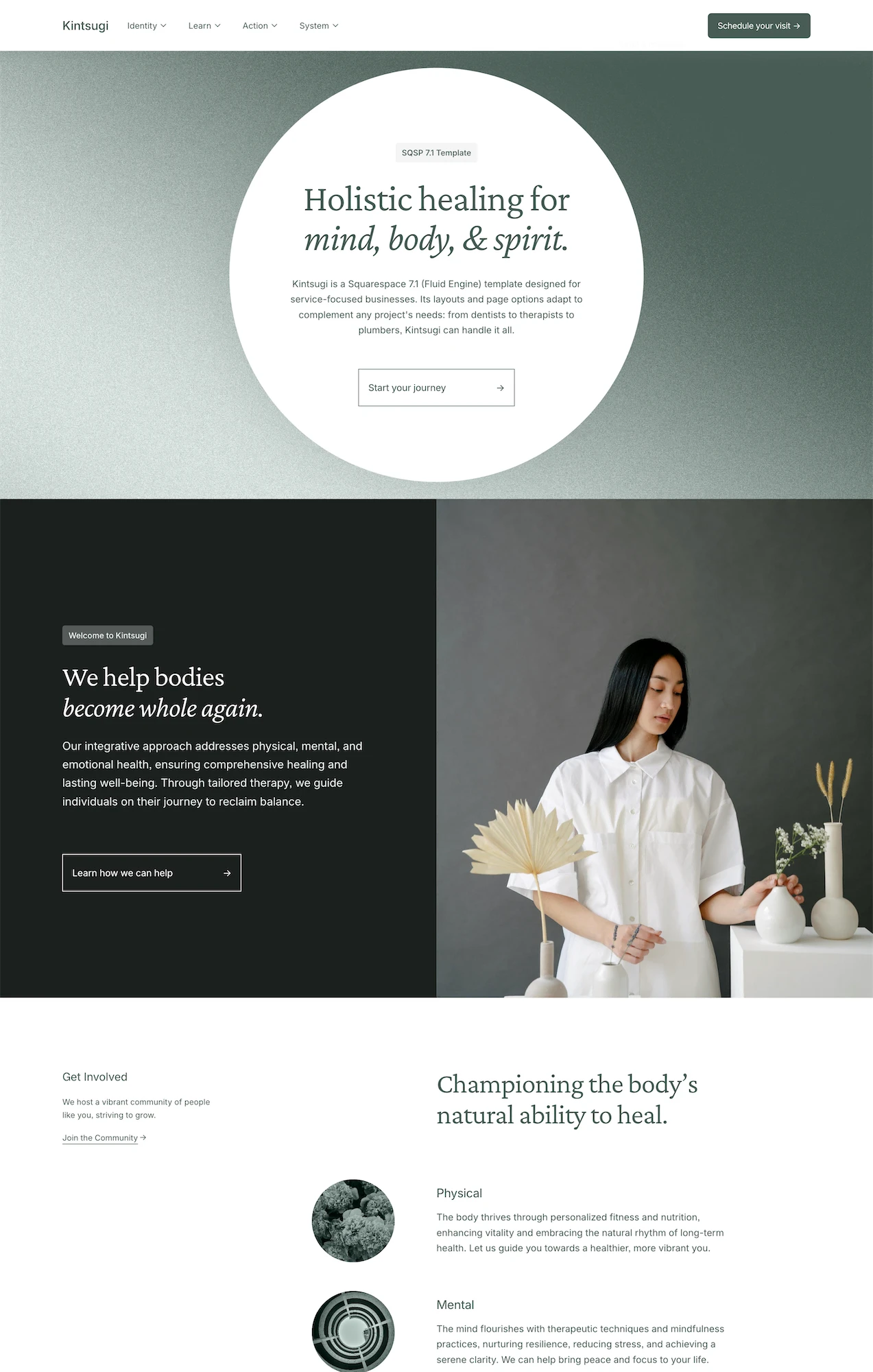
If you're building or rebuilding your therapy practice site on Squarespace, Kintsugi is a template designed specifically for therapists and wellness practitioners. It includes pages for individual specialties, a blog, and a contact page with structured intake forms. For a broader look at building a therapy site from the ground up, start with How to Build a Therapy Practice Website on Squarespace.
Article summary
Most therapy clients find their therapist through a Google search with a location attached. "Anxiety therapist in Denver." "Couples counseling Portland." "EMDR therapist near me." If your practice doesn't show up for those searches, you're invisible to the people most likely to book. This post covers the local SEO fundamentals that actually move the needle for therapy practices, with specific steps you can take on your Squarespace site.
Why Local SEO Matters for Therapists
Therapists operate in a geographic market. Unlike an online course creator or a SaaS company, your clients need to be within driving distance of your office (or within your state for telehealth). That makes local search your highest-value marketing channel.
When someone searches for a therapist in their city, Google serves two types of results: the local map pack (the three businesses shown with a map at the top) and the organic results below it. Showing up in either one puts you in front of someone with immediate intent. They're not browsing. They're looking for someone to call.
The good news is that local SEO for therapists is less competitive than local SEO for restaurants or plumbers. Most therapists aren't optimizing their web presence, which means a small amount of focused effort goes a long way.
Google Business Profile
Your Google Business Profile (GBP) is the foundation of local SEO. If you don't have one, create one at business.google.com. If you have one but haven't touched it in a year, update it now.
The Essentials
Business name. Use your actual practice name. Don't stuff keywords into it ("Denver Anxiety Therapist | Jane Smith Counseling"). Google penalizes keyword-stuffed business names.
Category. Set your primary category to the most specific option available. "Psychotherapist," "Marriage & Family Therapist," "Psychologist," or "Counselor" are all options. Your primary category should match your actual license and practice focus. Add secondary categories for additional specialties.
Address. If you see clients in-office, list your office address. If you're telehealth-only, you can set a service area without displaying an address, though this limits your visibility in the map pack.
Phone number. Use a local phone number, not a toll-free one. Local numbers signal geographic relevance to Google.
Hours. Set accurate hours and update them for holidays. Profiles with outdated hours get penalized in rankings.
Website link. Point this to your homepage or, even better, a dedicated landing page for your practice that includes your city and specialties.
Photos
Upload real photos of your office, your waiting room, and a professional headshot. Profiles with photos get significantly more engagement than profiles without. You don't need a professional photographer. A well-lit phone photo of a clean, welcoming space works fine.
Reviews
Google reviews are one of the strongest ranking factors for the local map pack. Ask satisfied clients if they'd be willing to leave a review. Some therapists feel uncomfortable with this, and that's understandable given the nature of the work. But a simple ask at the end of a successful course of treatment is appropriate and effective.
Respond to every review, positive or negative, with a brief, professional reply. Responses signal to Google that your profile is active.
Optimizing Your Squarespace Site for Local Search
Your Google Business Profile gets you into the map pack. Your website gets you into the organic results. Both matter.
Title Tags and Meta Descriptions
Every page on your Squarespace site should have a custom title tag and meta description set through the SEO panel in page settings. For a therapy practice, your homepage title should include your specialty, your city, and your name or practice name.
Example title tag: "Anxiety & Depression Therapist in Denver, CO | Pine Street Counseling"
Example meta description: "Licensed therapist in Denver specializing in anxiety, depression, and life transitions. Accepting new clients for in-person and telehealth sessions."
For your services pages, be specific about each offering: "Couples Counseling in Denver | Pine Street Counseling" is better than a generic "Services" title. The complete guide to Squarespace SEO covers title tags and meta descriptions in more depth.
Location-Specific Content
Include your city and state naturally throughout your site content. Your homepage, about page, and services pages should all mention where you practice. Don't force it into every sentence, but make sure Google can clearly identify your geographic focus.
Specific places to include your location:
Homepage headline or subheadline
About page (where you practice, areas you serve)
Services pages (mention the city in at least one heading or description)
Footer (your office address if you have a physical location)
Contact page
Create a Page for Each Service or Specialty
If you offer multiple specialties (anxiety, depression, couples counseling, EMDR), consider creating a dedicated page for each one rather than listing them all on a single services page. Each page becomes a separate ranking opportunity for a specific search query.
A page titled "EMDR Therapy in Denver" targeting the keyword "EMDR therapist Denver" has a much better chance of ranking than a generic services page that mentions EMDR once in a bulleted list. Your services page structure can serve as the hub that links to these individual pages.
Blog Content With Local Relevance
Publishing blog posts that mention your city in the context of mental health topics builds local authority over time. You don't need to blog weekly. One post per month on a topic your ideal clients are searching for is enough to make a difference.
Topic ideas with local angles:
"Finding the Right Therapist in [City]: What to Look For"
"How to Access Mental Health Resources in [City]"
"Navigating Stress During [Local Event or Season] in [City]"
These posts serve double duty: they rank for local long-tail keywords and they give visitors useful information that positions you as a knowledgeable practitioner in your area.
Directory Listings
Beyond Google, several therapy-specific directories drive meaningful traffic:
Psychology Today. This is still the dominant directory for therapists. Make sure your profile is complete, your specialties are accurate, and your profile photo is professional. Many therapists get a significant percentage of their new clients through Psychology Today.
TherapyDen. A newer, more inclusive directory with growing traffic.
GoodTherapy. Another established directory worth maintaining a profile on.
Your state or local professional association. Most state psychological and counseling associations have member directories. These listings often carry domain authority from established .org sites.
NAP Consistency
NAP stands for Name, Address, Phone number. These three pieces of information should be identical everywhere they appear online: your website, your Google Business Profile, Psychology Today, Yelp, and any other directory.
Inconsistencies (different phone numbers, slightly different business names, abbreviating "Street" in one place and spelling it out in another) confuse Google and can hurt your rankings. Pick one format and use it everywhere.
Schema Markup
Schema markup is structured data you add to your site's code that helps search engines understand what your business is and where it operates. For therapists, LocalBusiness or MedicalBusiness schema can highlight your practice name, address, phone number, specialties, and hours directly in search results.
Squarespace doesn't have a native schema editor, but you can add schema markup through code injection in your site settings. This is a more advanced step, but it can improve how your practice appears in search results. If you're comfortable with code, adding JSON-LD schema to your site header is the standard approach.
What to Prioritize First
If you're starting from scratch with local SEO, here's the order of operations:
Claim and fully complete your Google Business Profile
Set title tags and meta descriptions on every page of your Squarespace site
Add your city and state to your homepage headline and about page
Ask three to five current or past clients for Google reviews
Verify your NAP is consistent across your website, GBP, and Psychology Today
Create individual pages for your top two or three specialties
Everything else (blogging, schema markup, additional directories) is valuable but secondary. Nail the basics first and build from there.
Start Building
Local SEO for a therapy practice isn't complicated, but it requires consistency. The therapists who rank well in their cities aren't necessarily better clinicians. They're the ones who took the time to set up their online presence correctly and maintained it over time.
If you're building or rebuilding your therapy practice site on Squarespace, Kintsugi is a template designed specifically for therapists and wellness practitioners. It includes pages for individual specialties, a blog, and a contact page with structured intake forms. For a broader look at building a therapy site from the ground up, start with How to Build a Therapy Practice Website on Squarespace.
Article summary
Most therapy clients find their therapist through a Google search with a location attached. "Anxiety therapist in Denver." "Couples counseling Portland." "EMDR therapist near me." If your practice doesn't show up for those searches, you're invisible to the people most likely to book. This post covers the local SEO fundamentals that actually move the needle for therapy practices, with specific steps you can take on your Squarespace site.
Why Local SEO Matters for Therapists
Therapists operate in a geographic market. Unlike an online course creator or a SaaS company, your clients need to be within driving distance of your office (or within your state for telehealth). That makes local search your highest-value marketing channel.
When someone searches for a therapist in their city, Google serves two types of results: the local map pack (the three businesses shown with a map at the top) and the organic results below it. Showing up in either one puts you in front of someone with immediate intent. They're not browsing. They're looking for someone to call.
The good news is that local SEO for therapists is less competitive than local SEO for restaurants or plumbers. Most therapists aren't optimizing their web presence, which means a small amount of focused effort goes a long way.
Google Business Profile
Your Google Business Profile (GBP) is the foundation of local SEO. If you don't have one, create one at business.google.com. If you have one but haven't touched it in a year, update it now.
The Essentials
Business name. Use your actual practice name. Don't stuff keywords into it ("Denver Anxiety Therapist | Jane Smith Counseling"). Google penalizes keyword-stuffed business names.
Category. Set your primary category to the most specific option available. "Psychotherapist," "Marriage & Family Therapist," "Psychologist," or "Counselor" are all options. Your primary category should match your actual license and practice focus. Add secondary categories for additional specialties.
Address. If you see clients in-office, list your office address. If you're telehealth-only, you can set a service area without displaying an address, though this limits your visibility in the map pack.
Phone number. Use a local phone number, not a toll-free one. Local numbers signal geographic relevance to Google.
Hours. Set accurate hours and update them for holidays. Profiles with outdated hours get penalized in rankings.
Website link. Point this to your homepage or, even better, a dedicated landing page for your practice that includes your city and specialties.
Photos
Upload real photos of your office, your waiting room, and a professional headshot. Profiles with photos get significantly more engagement than profiles without. You don't need a professional photographer. A well-lit phone photo of a clean, welcoming space works fine.
Reviews
Google reviews are one of the strongest ranking factors for the local map pack. Ask satisfied clients if they'd be willing to leave a review. Some therapists feel uncomfortable with this, and that's understandable given the nature of the work. But a simple ask at the end of a successful course of treatment is appropriate and effective.
Respond to every review, positive or negative, with a brief, professional reply. Responses signal to Google that your profile is active.
Optimizing Your Squarespace Site for Local Search
Your Google Business Profile gets you into the map pack. Your website gets you into the organic results. Both matter.
Title Tags and Meta Descriptions
Every page on your Squarespace site should have a custom title tag and meta description set through the SEO panel in page settings. For a therapy practice, your homepage title should include your specialty, your city, and your name or practice name.
Example title tag: "Anxiety & Depression Therapist in Denver, CO | Pine Street Counseling"
Example meta description: "Licensed therapist in Denver specializing in anxiety, depression, and life transitions. Accepting new clients for in-person and telehealth sessions."
For your services pages, be specific about each offering: "Couples Counseling in Denver | Pine Street Counseling" is better than a generic "Services" title. The complete guide to Squarespace SEO covers title tags and meta descriptions in more depth.
Location-Specific Content
Include your city and state naturally throughout your site content. Your homepage, about page, and services pages should all mention where you practice. Don't force it into every sentence, but make sure Google can clearly identify your geographic focus.
Specific places to include your location:
Homepage headline or subheadline
About page (where you practice, areas you serve)
Services pages (mention the city in at least one heading or description)
Footer (your office address if you have a physical location)
Contact page
Create a Page for Each Service or Specialty
If you offer multiple specialties (anxiety, depression, couples counseling, EMDR), consider creating a dedicated page for each one rather than listing them all on a single services page. Each page becomes a separate ranking opportunity for a specific search query.
A page titled "EMDR Therapy in Denver" targeting the keyword "EMDR therapist Denver" has a much better chance of ranking than a generic services page that mentions EMDR once in a bulleted list. Your services page structure can serve as the hub that links to these individual pages.
Blog Content With Local Relevance
Publishing blog posts that mention your city in the context of mental health topics builds local authority over time. You don't need to blog weekly. One post per month on a topic your ideal clients are searching for is enough to make a difference.
Topic ideas with local angles:
"Finding the Right Therapist in [City]: What to Look For"
"How to Access Mental Health Resources in [City]"
"Navigating Stress During [Local Event or Season] in [City]"
These posts serve double duty: they rank for local long-tail keywords and they give visitors useful information that positions you as a knowledgeable practitioner in your area.
Directory Listings
Beyond Google, several therapy-specific directories drive meaningful traffic:
Psychology Today. This is still the dominant directory for therapists. Make sure your profile is complete, your specialties are accurate, and your profile photo is professional. Many therapists get a significant percentage of their new clients through Psychology Today.
TherapyDen. A newer, more inclusive directory with growing traffic.
GoodTherapy. Another established directory worth maintaining a profile on.
Your state or local professional association. Most state psychological and counseling associations have member directories. These listings often carry domain authority from established .org sites.
NAP Consistency
NAP stands for Name, Address, Phone number. These three pieces of information should be identical everywhere they appear online: your website, your Google Business Profile, Psychology Today, Yelp, and any other directory.
Inconsistencies (different phone numbers, slightly different business names, abbreviating "Street" in one place and spelling it out in another) confuse Google and can hurt your rankings. Pick one format and use it everywhere.
Schema Markup
Schema markup is structured data you add to your site's code that helps search engines understand what your business is and where it operates. For therapists, LocalBusiness or MedicalBusiness schema can highlight your practice name, address, phone number, specialties, and hours directly in search results.
Squarespace doesn't have a native schema editor, but you can add schema markup through code injection in your site settings. This is a more advanced step, but it can improve how your practice appears in search results. If you're comfortable with code, adding JSON-LD schema to your site header is the standard approach.
What to Prioritize First
If you're starting from scratch with local SEO, here's the order of operations:
Claim and fully complete your Google Business Profile
Set title tags and meta descriptions on every page of your Squarespace site
Add your city and state to your homepage headline and about page
Ask three to five current or past clients for Google reviews
Verify your NAP is consistent across your website, GBP, and Psychology Today
Create individual pages for your top two or three specialties
Everything else (blogging, schema markup, additional directories) is valuable but secondary. Nail the basics first and build from there.
Start Building
Local SEO for a therapy practice isn't complicated, but it requires consistency. The therapists who rank well in their cities aren't necessarily better clinicians. They're the ones who took the time to set up their online presence correctly and maintained it over time.
If you're building or rebuilding your therapy practice site on Squarespace, Kintsugi is a template designed specifically for therapists and wellness practitioners. It includes pages for individual specialties, a blog, and a contact page with structured intake forms. For a broader look at building a therapy site from the ground up, start with How to Build a Therapy Practice Website on Squarespace.