Squarespace Alternatives: What Switching Costs in Hours, Not Dollars
Whenever a website platform changes its pricing, the same article appears: ten Squarespace alternatives, ranked by monthly cost. That list is the wrong tool for the decision, because the monthly cost is the smallest number in it. The number that decides it is how many hours the move takes, and almost nobody puts that on the chart.
Squarespace's July 2026 increase is the worked example I have used throughout. It is also stranger than the coverage suggested: the increase is real, it reached the pricing page months before it reached anyone's inbox, and one plan was left alone entirely.
What actually changed
Squarespace emailed existing customers on July 6 and 7. The forum reaction was immediate. A Platinum Partner reported Core renewals going from $276 to $348, about 26 percent. A Gold Partner who administers more than 100 client sites said it lands hardest on the hospitality businesses and nonprofits they serve. Another, on the platform since 2012, called it a dealbreaker.
The published prices moved too, and that is the part the coverage missed. Squarespace raised its list prices through a phased rollout across roughly May to July, before most of those emails went out. You can watch it happen in archived copies of Squarespace's own checkout API: captures taken minutes apart returned different prices to different visitors, which is what a split test looks like from the outside. The new plan codes are named for it. They read apr-2026-us-increase.
Plan
Was
Now
Change
Billed monthly
Custom code
Digital content fee
Basic
$192/yr
$228/yr
+19%
$25/mo
CSS only
7%
Core
$276/yr
$348/yr
+26%
$39/mo
Yes
5%
Plus
$468/yr
$588/yr
+26%
$65/mo
Yes
1%
Advanced
$1,188/yr
$1,188/yr
No change
$139/mo
Yes
0%
Advanced did not move. That detail tells you who the increase was aimed at: the three tiers that went up are the ones small businesses actually buy, and the one that stayed flat costs more than the other three combined.
The increase is real, it ran between 19 and 26 percent, and it reached the pricing page months before it reached your inbox. The only plan that did not move is the most expensive one.
Your own number still depends on when you signed up. Anyone holding an older rate sees the full jump at renewal, and anyone who signed up recently was already paying the new price. So compare your invoice to the published price before you price up a migration. That gap, not the percentage in the headlines, is your actual increase. Core is the baseline for everything below, because it is where custom code lives and it is the plan most of this conversation is about. Call it $348 a year, and call the increase $72.
Every alternative, honestly compared
Most comparisons are useless because they quote each platform's cheapest tier, which is never the tier you would land on. Every plan below is the cheapest one that clears the same bar Core clears: your own domain, a real blog, no platform branding, and enough pages to be a genuine site.
Platform
Plan
Per year
Difficulty
Best thing
Cannot do
Move?
Google Sites
Free
$0
Easy
Free forever
No blog or store
No
Carrd
Pro Standard
$19
Easy
Fastest one-pager
One page, no blog
Link pages
WordPress.com
Personal
$48
Moderate
60,000 plugins
Payments cost more
If you tinker
Framer
Basic
$120
Moderate
Motion design
30 pages, paid seats
Landing pages
Canva
Pro
$144
Easy
Already familiar
No blog, 45 pages
No
Cargo
Cargo
$168
Hard
Design freedom
No CMS
Portfolios
Readymag
Personal
$168
Moderate
Art direction
No CMS, metered
No
Ghost
Starter
$180
Moderate
Newsletters
No store
If you publish
GoDaddy
Basic
$120, then $204
Easy
Phone support
Thin design
No
Wix
Light
$204
Moderate
Real JavaScript
No store
If you need code
Format
Pro
$204
Easy
Client galleries
15 products
For photographers
Webflow
Premium
$300
Hard
Highest ceiling
$39/mo per seat
With a budget
Showit
Starter Blog
$326
Moderate
Separate mobile
Two systems
For weddings
Squarespace
Core
$348
Baseline
All on one bill
Baseline
You are here
Wix
Core
$348
Moderate
More apps
Template discipline
No
Shopify
Basic
$348
Moderate
Best checkout
No staff logins
To sell
Self-hosted WP
Varies
$131 to $1,073
Hard
You own it
You maintain it
If you enjoy it
Build your own
Static host
About $11
Hard
No landlord
You are support
If you code
Where a platform publishes only a monthly rate, the annual figure is that rate times twelve. Check any number you plan to act on: Format's $204 is currently discounted to $144 for a first year, and Webflow repriced its entire lineup in May 2026, which tells you something about how stable these alternatives are.
Five of the cheapest rows cannot run a blog at all. Google Sites is free forever with a real domain and no branding, and has no blog, no feed and no store. Canva Pro stops at 45 pages with no post type and no dates. Carrd builds exactly one page. Cargo gives you real design freedom for $168 and no CMS at all, so every post is a page you build and order by hand. Readymag has no CMS at all and meters you at 10,000 views a month, where Squarespace meters nothing. If your site is a portfolio and you will never publish, several of these are genuinely good and genuinely cheap. If you want search traffic, a platform that cannot produce a dated, feedable archive cannot earn it.
The cheapest options on that table are cheap because they cannot do the job. The ones that can do the job cost roughly what you are already paying.
Wix is the alternative most people reach for first. Its Light plan at $204 genuinely clears the bar, but the moment you want to sell anything you are on Wix Core at $348, the identical figure you left. Shopify Basic lands on $348 too, and gives you zero staff logins for it. I wrote up what moving from Squarespace to Webflow involved, and the conclusion was not that Webflow is worse. It is that the move costs more than the sticker suggests.
The bill that does not appear on the pricing page
Self-hosted WordPress is where people land when a subscription starts to look expensive, because the software is free. The software is free. The website is not.
Hosting is where the advertised price and the price you pay separate. Hostinger's plan marketed at $2.99 a month is 48 months bought upfront, and it renews at $10.99. Bluehost moves from $3.99 to $9.99. SiteGround has the sharpest edge I found: $2.99 for twelve months, then $17.99, a sixfold increase in year two. The headline monthly rate is not a monthly rate at all. It is a multi-year prepayment divided by its own term.
Then the stack. At renewal prices, a loaded WordPress site runs about $1,073 a year once you add a premium theme, forms, caching, SEO tooling, security and backups. Strip it to free plugins and renewal-rate shared hosting and the floor is about $131, which genuinely undercuts Squarespace. Most small businesses land between $300 and $500.
The floor for self-hosted WordPress really does beat Squarespace. The ceiling is three times the price. Both make you the person patching the site at 11pm when an update takes the contact form down.
This belongs on the list in a way it did not two years ago. Point Claude, Lovable, Codex or any of their siblings at a blank folder, describe your site, and you will have real code in an afternoon. Push it to a static host and the running cost is a domain, about $11 a year. It is also the only option here that ends the renting, because there is no landlord to reprice you.
Three things the enthusiasm leaves out:
Free hosting carries a commercial asterisk. Vercel's fair-use guidelines restrict the free Hobby plan to non-commercial use, and a business site there needs Pro at $240 a year, which lands you back beside the platforms you left
An AI writes the code but it does not carry the pager. Nobody is patching your dependencies, nothing warns you that the contact form broke three weeks ago, and there is no support line
The build is the easy afternoon and the finish is the long month. Forms, meta tags, image performance, redirect mapping, analytics and mobile layout are where the hours go, and every one of them arrives free with a subscription
Building your own is the cheapest row by cash and the most expensive by time. It is a $337 saving that costs a hundred hours, and the hours never stop.
The break-even, measured in hours
Here is the step every list of alternatives skips. Do not guess how long a migration takes. Invert the question instead: take what a platform saves per year, divide by what an hour of your time is worth, and you get the number of hours the move must fit inside before it costs more than it saves. Say your hour is worth $75.
Where you land
Saved per year
Hours to break even in year one
Over five years
Build it yourself with AI
$337
4.5 hours
22 hours
WordPress.com Personal
$300
4.0 hours
20 hours
Framer Basic
$228
3.0 hours
15 hours
GoDaddy, Wix Light or Format Pro
$144
1.9 hours
9.6 hours
Webflow Premium
$48
38 minutes
3.2 hours
Showit with a blog
$22
18 minutes
1.5 hours
Wix Core or Shopify Basic
$0
Never
Never
The most generous row gives you four and a half hours, and it is the row that takes longest by a distance. Inside that you have to rebuild every page in an unfamiliar editor, move the copy and images and repair what the transfer mangled, rebuild the forms and rewire where they send, map every old URL to its new address, test on phones, and reconnect the domain, the mailboxes and the analytics.
Four and a half hours is the best offer on the table. Nobody rebuilds a website in four and a half hours.
That last item is the one that costs real money. Your URLs change when your platform changes, and every link you have earned points at the old ones. Done carefully, redirects keep the damage small and short. Rushed, the pages you spent years ranking are the ones that pay.
A photographer with a two-page portfolio, no blog and no third-party template: drop to Basic. It is $228 a year, saves $120, and needs no migration. What you give up is custom code, which you are not using
A therapist, lawyer or consultant with a handful of pages and a blog: stay on Core. The increase is real, and it is still $72. Everything that saves more costs a rebuild you would feel for months
You want the cheapest site that is still a real site: WordPress.com Personal at $48. It is the one genuine bargain here, with unlimited pages, no traffic cap and a real blog. Budget a weekend, and $13 a year for the domain after the first
Selling courses or memberships: do the fee math instead. Core takes 5 percent of digital content sales and Plus takes 1 percent while costing $240 more, so past roughly $6,000 a year Plus is cheaper. Past roughly $16,800, Advanced beats Core outright, and Advanced is the one plan whose price did not just rise
A small shop with a few physical products: stay on Core, which already takes zero on store sales. Shopify Basic is the same $348, adds 2 percent unless you use Shopify Payments, and gives you no staff logins
Paying month to month: switch to annual billing today. On Core that is $120 a year for one click and no migration
A single landing page, no blog, no team: take Framer Basic at $120. This is the one case where leaving straightforwardly wins, because there is almost nothing to move
Notice how many of these end with a tier change rather than a platform change. The cheapest fix is nearly always a setting you have not looked at.
You were always renting
Underneath the reaction in those threads is something more interesting than money: the feeling of discovering you are a tenant in a house you thought was yours. That is worth taking seriously, and then being precise about, because the conclusion people draw from it is usually wrong.
You were always renting. Squarespace, Wix, Framer, Format, Showit, Webflow, Shopify, GoDaddy, Canva, WordPress.com: every one is a landlord. Stop paying any of them and the site goes dark. Switching does not convert you from tenant to owner. It moves you to a landlord who has not raised your rent yet and who reserves the same right to do it whenever they like. Webflow repriced its entire lineup in May 2026. GoDaddy's cheapest plan renews 70 percent above the price it advertises, and that number appears nowhere on its pricing page. You have to put the thing in a cart to find it.
Switching platforms does not make you an owner. It makes you a tenant of someone who has not raised your rent yet.
It is worth knowing exactly how portable your content is, because the answer is less than you would hope. Squarespace's export produces a single WordPress file holding your pages and one blog. It leaves behind your store and every product, your members, your courses, your portfolios, your custom CSS and every style setting you chose. Images come across as links pointing back at Squarespace, and those stop working when the site goes away. Squarespace's own documentation is blunt that you cannot even import that file into another Squarespace site.
So be precise about what you own. The domain is yours outright. The content is yours too, but only partly portable, which means the backup is on you: your words somewhere you control and your images at full resolution, saved before you need them rather than after. Do that and no landlord can hold you hostage. That is the real answer to the ownership question, and it requires moving nothing. If you have never checked which registrar holds your domain, that is the one piece of homework this article is asking for.
The complaint underneath the complaint
The increase is $36 a year on Basic, $72 on Core, $120 on Plus and nothing on Advanced. On Core that is $6 a month, or about 20 cents a day. One client, one booking, one sale, one donation covers the whole year. If your site cannot produce $72 across twelve months, the increase is not what is wrong. The site is not working, and none of these alternatives will make it work, because you will have the same pages saying the same things to the same nobody, on a platform you now have to relearn.
If your site cannot earn $72 in a year, the renewal notice is a diagnostic rather than the disease.
The people with a real grievance are the nonprofits and small operators running a working site on thin margins, where $72 is a genuine line item. That is who the Gold Partner was speaking for, and it is fair. Even there the answer is a tier review rather than a rebuild, because the rebuild costs more than the increase in every scenario above. My breakdown of what a small business website costs in 2026 puts the subscription against everything else in that column.
For everyone else, nobody cancels something they love over $6 a month. If your site were pulling in clients, if it looked like the business you meant to build, a $6 increase would be an email you deleted. A renewal notice lands differently when you are being asked to pay more for a site you already did not like. That is not a pricing problem. It is a design problem that finally found an occasion to speak.
Nobody cancels something they love over $6 a month. The renewal only stings when you are paying more for a site you already did not like.
The problem is not that Squarespace costs $348. It is that the site does not look like it is worth $348, and every renewal is a reminder. Moving to Wix does not fix that. You would rebuild the same tired pages in an unfamiliar editor, pay the identical $348, and be disappointed on a new platform. What aged was the design, not the hosting, and design follows you.
Now the disclosure you deserve. I make Squarespace templates, so I have an obvious interest in you staying, and you should weigh this article accordingly. Two things make that weighing fair. Every number here is a published price you can check yourself, including the ones that beat me. And my own site is not built on Squarespace at all: it is custom code on a static host, the cheapest row in the table, because building websites is what I do all day. I took the expensive-in-hours road because hours spent on websites are my job. If they are not yours, the arithmetic points somewhere else.
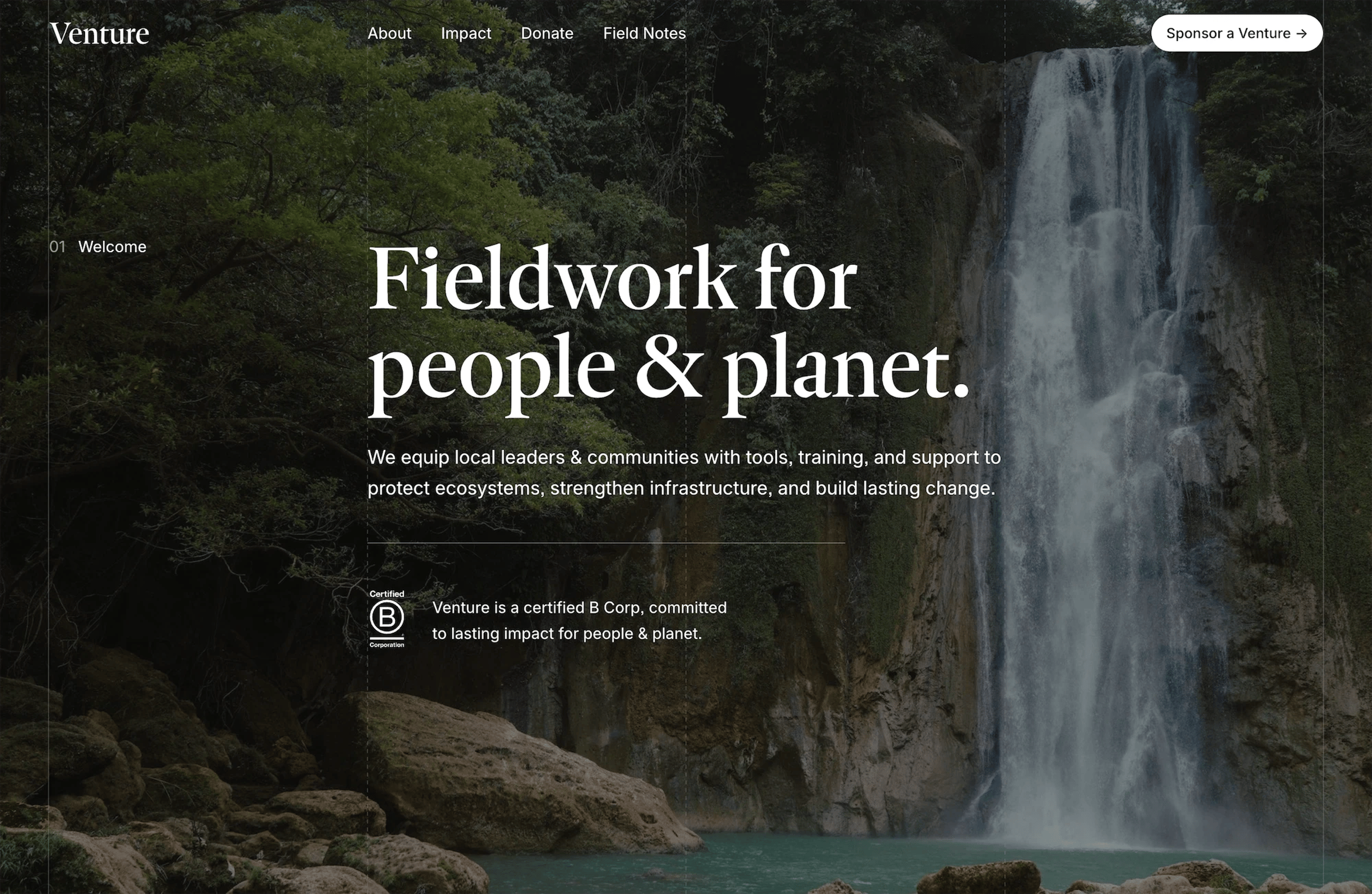
With that on the table: a template is a one-time cost against a rebuild, and it is the one move on this page that does not ask you to learn anything. It is a separate site rather than a skin for your existing one, so your content moves across and your renewal date starts fresh. Your domain and your URLs can come with you, because you control the slugs and you are not changing platforms. That is the honest version: hours, but not the expensive kind. I build for the businesses in those threads: Venture for nonprofits and Learnable for course creators. Each needs its own Core plan or above, and the case for paying for a template rather than using a free one is worth reading first.
One warning in the other direction, and it corrects something Squarespace's own plan cards get wrong: the CSS editor is available on every tier, including Basic. What Basic lacks is code injection and the advanced code block, so a Basic site can be restyled but cannot load a script. That still makes it a trap for most third-party templates, which is worth knowing precisely rather than vaguely. The tiers below Core cost less because they do less, which is the lesson this article keeps teaching in different currencies. My buyer's guide to premium templates covers what to check before you spend.
Frequently asked questions
Did Squarespace raise prices in July 2026?
Yes, and by more than the renewal emails suggested. Basic went from $192 to $228 a year, Core from $276 to $348, and Plus from $468 to $588, so between 19 and 26 percent. Advanced did not change at all. The list prices moved through a phased rollout across roughly May to July, which means the increase reached the pricing page before it reached anyone's inbox. What you see at renewal depends on the rate you were locked at, so compare your invoice to the published price rather than the percentage in the headlines.
What is the cheapest real alternative to Squarespace?
WordPress.com Personal at $48 a year, and it is not close. You get a real blog, unlimited pages, no traffic cap and no ads, though taking payments natively pushes you to the $96 tier and the domain costs about $13 a year after the first. Below that, Framer Basic is $120 but caps you at 30 pages and charges $20 a month per extra editor. Everything cheaper than those two, including Canva, Carrd and Google Sites, cannot run a blog.
Is Wix cheaper than Squarespace?
Its Light plan is, at $204 a year against Core's $348, and Light does give you a custom domain, a blog and no Wix branding. But Light cannot sell anything. The moment you want a store you are on Wix Core at $348, the identical figure you left.
Do I own my website on Squarespace?
You own your domain and your content. You rent everything else, and that is true on every hosted platform in the table above. Only two routes end the renting: self-hosted WordPress, and building your own site and hosting the code yourself. Both trade rent for maintenance that costs more per year in hours than the subscription did in dollars. Keep your domain under your control and your content backed up, and you are never trapped regardless of who you pay.
Is Squarespace still worth it?
For most service businesses, yes. At $348 a year you are buying hosting, bandwidth, SSL, security patches, uptime, support and a platform that does not ask you to maintain it. The alternatives that beat that number on cash give you between 38 minutes and four and a half hours to complete the move before it costs more than it saves. I made the case for Squarespace as the right builder for most brands before any of this, and a 26 percent increase does not overturn it.
Three steps, in this order, before you do anything else:
Open your invoice and find what you are paying now
Subtract it from the published price for your plan. That difference, not the percentage in the headlines, is your increase
Divide it by your hourly rate. That is how many hours the move is allowed to take
Then ask the question underneath: would this site be worth keeping if you liked it? For nearly everyone weighing Squarespace alternatives, that last one is what was being asked all along.