Article summary
A mission statement that works in a boardroom doesn't always work on a website. Annual reports and grant applications tolerate longer, more formal language. Your website doesn't. Online visitors scan, skim, and decide in seconds whether to stay or leave. Your mission statement needs to land instantly. This post covers how to write one that reads well on a screen, where to place it on your site, and the most common mistakes nonprofits make with this one critical piece of copy.
What a website mission statement needs to do
Your mission statement on your website has a different job than the one in your bylaws. On the website, it needs to accomplish three things in a single read:
Say what you do. Not in abstract terms, but in concrete ones. "Providing educational resources" is vague. "Teaching financial literacy to first-generation college students" is clear.
Say who you serve. The people you help should be identifiable. If your mission statement could apply to any nonprofit in any sector, it's too broad.
Imply why it matters. You don't need to state the problem explicitly in the mission statement itself, but the reader should immediately understand the gap your organization fills.
If your current mission statement hits all three in under 25 words, you're in good shape. If it takes a full paragraph, there's room to tighten.
Writing the statement
Start with a simple sentence
Before you worry about language, answer this question in the plainest terms you can: What does your organization do, and for whom?
Write it as a sentence you'd say to someone at a dinner party. Not a fundraising pitch. Not a grant proposal opener. Just a direct answer.
"We help refugees in the Portland metro area find stable housing and employment within their first year of resettlement."
That's a mission statement. It's specific, it names the population served, it describes the outcome, and it includes a geographic and temporal frame. Most organizations can get to something this clear if they resist the urge to make it sound impressive.
Remove the filler
Mission statements accumulate filler words over time, especially when they're written by committee. Look for these patterns and cut them:
"We are committed to..." — This is throat-clearing. Drop it and start with the verb.
"We strive to..." / "We seek to..." — These hedge. Either you do it or you don't. Say what you do.
"Empowering communities through innovative solutions..." — Abstract language that could mean anything. Replace with specifics.
"We believe that..." — Beliefs belong on your about page. Your mission statement should describe action, not philosophy.
Keep it under 25 words
This isn't an arbitrary rule. It's a practical constraint based on how people read on screens. A mission statement under 25 words can be displayed in a homepage hero section, read at a glance on mobile, and remembered after one encounter.
If you can't get it under 25 words, it's usually a sign that you're trying to say too much. Move the supporting context to your about page, where you have room to elaborate.
Where to put it on your site
Homepage
Your mission statement belongs above the fold on your homepage, usually as the primary headline or as a supporting line directly beneath it. This is the single most important piece of text on your entire website. Visitors should understand what your organization does within seconds of landing on your site.
For more on structuring your homepage effectively, check out Homepage Design Principles: What to Put Above the Fold.
About page
Your about page is where you expand on the mission statement with context, history, and values. The mission statement should appear near the top, followed by the story of why the organization exists, who founded it, and what you've accomplished.
Footer
Including a short version of your mission statement in the site footer ensures it's visible on every page without taking up primary content space. This is a subtle but effective reinforcement.
Mission statement vs. tagline
These are related but different. Your mission statement is a complete description of what you do. Your tagline is a shorter, more memorable distillation used for branding.
Mission Statement | Tagline | |
|---|---|---|
Length | 15–25 words | 3–8 words |
Purpose | Explains what you do | Creates recall and identity |
Tone | Clear, informative | Evocative, memorable |
Placement | Homepage, about page | Logo lockup, header, social bios |
Example | "We provide free legal representation to tenants facing eviction in Cook County." | "Housing is a right." |
You don't need both, but if you have a tagline, make sure it doesn't replace the mission statement on your website. Taglines create feeling. Mission statements create understanding. Your site needs the latter.
Common mistakes
Writing for the board instead of the public. Internal stakeholders know your acronyms, your programs, and your strategic plan. Website visitors don't. Write the mission statement for someone encountering your organization for the first time.
Listing every program and initiative. Your mission statement describes your overarching purpose, not your program catalog. Individual programs belong on their own pages.
Using the word "community" without context. "Serving our community" doesn't tell the visitor which community, where, or how. Be specific.
Changing it for SEO. Your mission statement should be written for humans. Keyword optimization belongs in page titles, meta descriptions, and body copy, not in the one sentence that defines your organization. For guidance on where SEO effort actually matters, read The Complete Guide to Squarespace SEO.
Hiding it on a subpage. If your mission statement only lives on an "Our Mission" page three clicks deep, most visitors will never see it. Put it on the homepage.
Examples of clear mission statements
These aren't from real organizations, but they illustrate the principles above:
"We train and employ formerly incarcerated women in professional culinary careers in Detroit."
"Free after-school tutoring for K–8 students in rural Appalachia."
"Connecting retired veterans with mental health resources across the Southeast."
Each one tells you what the organization does, who it serves, and where it operates. No jargon, no filler, no ambiguity.
How this fits into your full site
Your mission statement is the foundation, but a nonprofit website needs much more than a strong opening line. The pages that surround it, including your programs page, impact section, donation flow, and volunteer signup, all need to reinforce and expand on that central message.
For a full walkthrough of building out a nonprofit website, read How to Build a Nonprofit Website on Squarespace. If you're working on a limited budget, How Much Does a Nonprofit Website Cost in 2026 covers realistic numbers and where to invest.
Start building
A clear mission statement makes every other part of your website easier to build. Once you know exactly what you do and who you serve, the homepage writes itself, the donation ask makes sense, and visitors stick around longer.
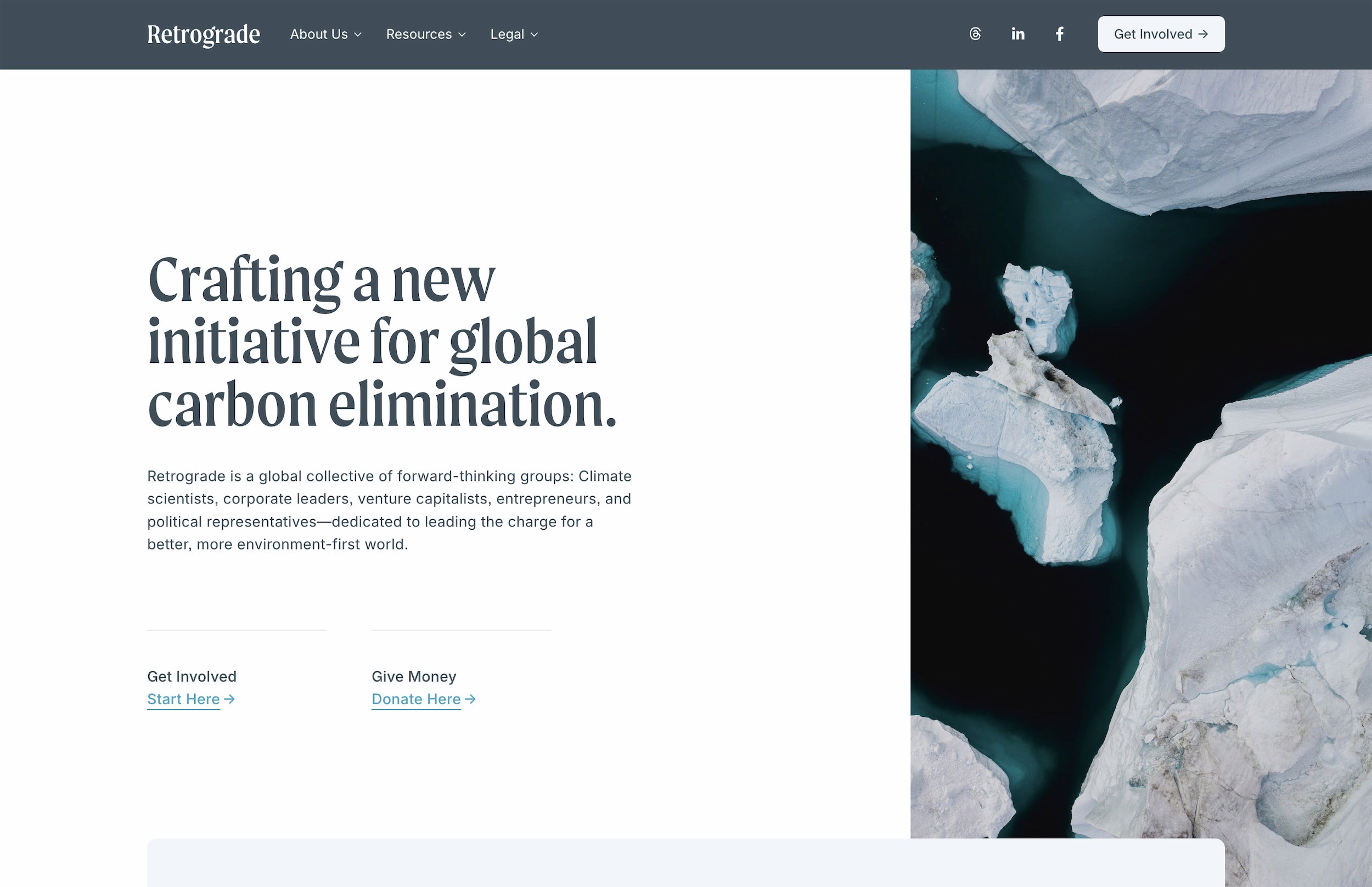
Venture and Retrograde are Squarespace templates built specifically for nonprofits. Both include homepage layouts designed to feature your mission prominently, along with donation flows, impact storytelling pages, and volunteer signup sections. Every purchase includes an unlimited license and a 30% nonprofit discount.
Article summary
A mission statement that works in a boardroom doesn't always work on a website. Annual reports and grant applications tolerate longer, more formal language. Your website doesn't. Online visitors scan, skim, and decide in seconds whether to stay or leave. Your mission statement needs to land instantly. This post covers how to write one that reads well on a screen, where to place it on your site, and the most common mistakes nonprofits make with this one critical piece of copy.
What a website mission statement needs to do
Your mission statement on your website has a different job than the one in your bylaws. On the website, it needs to accomplish three things in a single read:
Say what you do. Not in abstract terms, but in concrete ones. "Providing educational resources" is vague. "Teaching financial literacy to first-generation college students" is clear.
Say who you serve. The people you help should be identifiable. If your mission statement could apply to any nonprofit in any sector, it's too broad.
Imply why it matters. You don't need to state the problem explicitly in the mission statement itself, but the reader should immediately understand the gap your organization fills.
If your current mission statement hits all three in under 25 words, you're in good shape. If it takes a full paragraph, there's room to tighten.
Writing the statement
Start with a simple sentence
Before you worry about language, answer this question in the plainest terms you can: What does your organization do, and for whom?
Write it as a sentence you'd say to someone at a dinner party. Not a fundraising pitch. Not a grant proposal opener. Just a direct answer.
"We help refugees in the Portland metro area find stable housing and employment within their first year of resettlement."
That's a mission statement. It's specific, it names the population served, it describes the outcome, and it includes a geographic and temporal frame. Most organizations can get to something this clear if they resist the urge to make it sound impressive.
Remove the filler
Mission statements accumulate filler words over time, especially when they're written by committee. Look for these patterns and cut them:
"We are committed to..." — This is throat-clearing. Drop it and start with the verb.
"We strive to..." / "We seek to..." — These hedge. Either you do it or you don't. Say what you do.
"Empowering communities through innovative solutions..." — Abstract language that could mean anything. Replace with specifics.
"We believe that..." — Beliefs belong on your about page. Your mission statement should describe action, not philosophy.
Keep it under 25 words
This isn't an arbitrary rule. It's a practical constraint based on how people read on screens. A mission statement under 25 words can be displayed in a homepage hero section, read at a glance on mobile, and remembered after one encounter.
If you can't get it under 25 words, it's usually a sign that you're trying to say too much. Move the supporting context to your about page, where you have room to elaborate.
Where to put it on your site
Homepage
Your mission statement belongs above the fold on your homepage, usually as the primary headline or as a supporting line directly beneath it. This is the single most important piece of text on your entire website. Visitors should understand what your organization does within seconds of landing on your site.
For more on structuring your homepage effectively, check out Homepage Design Principles: What to Put Above the Fold.
About page
Your about page is where you expand on the mission statement with context, history, and values. The mission statement should appear near the top, followed by the story of why the organization exists, who founded it, and what you've accomplished.
Footer
Including a short version of your mission statement in the site footer ensures it's visible on every page without taking up primary content space. This is a subtle but effective reinforcement.
Mission statement vs. tagline
These are related but different. Your mission statement is a complete description of what you do. Your tagline is a shorter, more memorable distillation used for branding.
Mission Statement | Tagline | |
|---|---|---|
Length | 15–25 words | 3–8 words |
Purpose | Explains what you do | Creates recall and identity |
Tone | Clear, informative | Evocative, memorable |
Placement | Homepage, about page | Logo lockup, header, social bios |
Example | "We provide free legal representation to tenants facing eviction in Cook County." | "Housing is a right." |
You don't need both, but if you have a tagline, make sure it doesn't replace the mission statement on your website. Taglines create feeling. Mission statements create understanding. Your site needs the latter.
Common mistakes
Writing for the board instead of the public. Internal stakeholders know your acronyms, your programs, and your strategic plan. Website visitors don't. Write the mission statement for someone encountering your organization for the first time.
Listing every program and initiative. Your mission statement describes your overarching purpose, not your program catalog. Individual programs belong on their own pages.
Using the word "community" without context. "Serving our community" doesn't tell the visitor which community, where, or how. Be specific.
Changing it for SEO. Your mission statement should be written for humans. Keyword optimization belongs in page titles, meta descriptions, and body copy, not in the one sentence that defines your organization. For guidance on where SEO effort actually matters, read The Complete Guide to Squarespace SEO.
Hiding it on a subpage. If your mission statement only lives on an "Our Mission" page three clicks deep, most visitors will never see it. Put it on the homepage.
Examples of clear mission statements
These aren't from real organizations, but they illustrate the principles above:
"We train and employ formerly incarcerated women in professional culinary careers in Detroit."
"Free after-school tutoring for K–8 students in rural Appalachia."
"Connecting retired veterans with mental health resources across the Southeast."
Each one tells you what the organization does, who it serves, and where it operates. No jargon, no filler, no ambiguity.
How this fits into your full site
Your mission statement is the foundation, but a nonprofit website needs much more than a strong opening line. The pages that surround it, including your programs page, impact section, donation flow, and volunteer signup, all need to reinforce and expand on that central message.
For a full walkthrough of building out a nonprofit website, read How to Build a Nonprofit Website on Squarespace. If you're working on a limited budget, How Much Does a Nonprofit Website Cost in 2026 covers realistic numbers and where to invest.
Start building
A clear mission statement makes every other part of your website easier to build. Once you know exactly what you do and who you serve, the homepage writes itself, the donation ask makes sense, and visitors stick around longer.
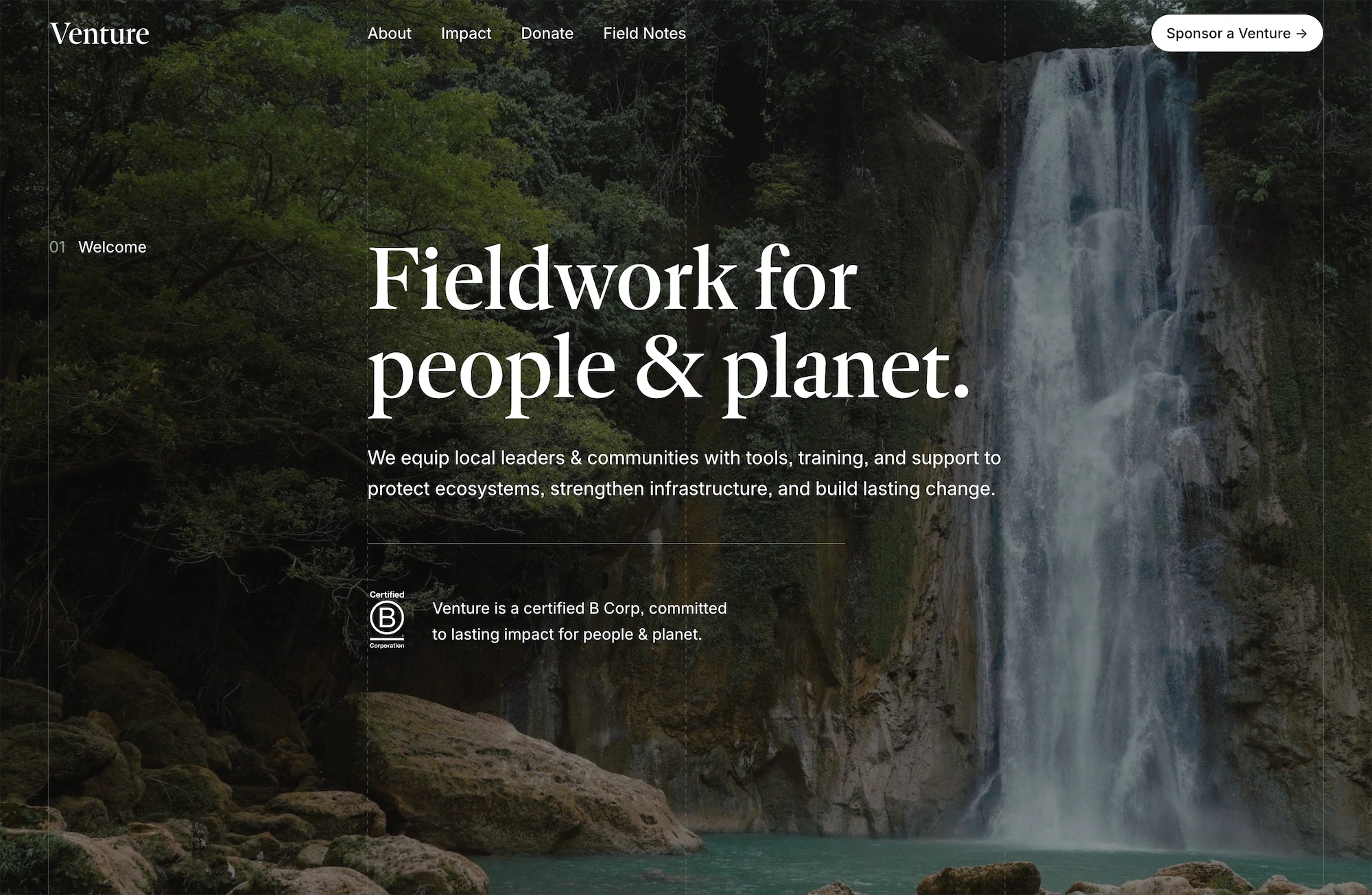
Venture and Retrograde are Squarespace templates built specifically for nonprofits. Both include homepage layouts designed to feature your mission prominently, along with donation flows, impact storytelling pages, and volunteer signup sections. Every purchase includes an unlimited license and a 30% nonprofit discount.
Article summary
A mission statement that works in a boardroom doesn't always work on a website. Annual reports and grant applications tolerate longer, more formal language. Your website doesn't. Online visitors scan, skim, and decide in seconds whether to stay or leave. Your mission statement needs to land instantly. This post covers how to write one that reads well on a screen, where to place it on your site, and the most common mistakes nonprofits make with this one critical piece of copy.
What a website mission statement needs to do
Your mission statement on your website has a different job than the one in your bylaws. On the website, it needs to accomplish three things in a single read:
Say what you do. Not in abstract terms, but in concrete ones. "Providing educational resources" is vague. "Teaching financial literacy to first-generation college students" is clear.
Say who you serve. The people you help should be identifiable. If your mission statement could apply to any nonprofit in any sector, it's too broad.
Imply why it matters. You don't need to state the problem explicitly in the mission statement itself, but the reader should immediately understand the gap your organization fills.
If your current mission statement hits all three in under 25 words, you're in good shape. If it takes a full paragraph, there's room to tighten.
Writing the statement
Start with a simple sentence
Before you worry about language, answer this question in the plainest terms you can: What does your organization do, and for whom?
Write it as a sentence you'd say to someone at a dinner party. Not a fundraising pitch. Not a grant proposal opener. Just a direct answer.
"We help refugees in the Portland metro area find stable housing and employment within their first year of resettlement."
That's a mission statement. It's specific, it names the population served, it describes the outcome, and it includes a geographic and temporal frame. Most organizations can get to something this clear if they resist the urge to make it sound impressive.
Remove the filler
Mission statements accumulate filler words over time, especially when they're written by committee. Look for these patterns and cut them:
"We are committed to..." — This is throat-clearing. Drop it and start with the verb.
"We strive to..." / "We seek to..." — These hedge. Either you do it or you don't. Say what you do.
"Empowering communities through innovative solutions..." — Abstract language that could mean anything. Replace with specifics.
"We believe that..." — Beliefs belong on your about page. Your mission statement should describe action, not philosophy.
Keep it under 25 words
This isn't an arbitrary rule. It's a practical constraint based on how people read on screens. A mission statement under 25 words can be displayed in a homepage hero section, read at a glance on mobile, and remembered after one encounter.
If you can't get it under 25 words, it's usually a sign that you're trying to say too much. Move the supporting context to your about page, where you have room to elaborate.
Where to put it on your site
Homepage
Your mission statement belongs above the fold on your homepage, usually as the primary headline or as a supporting line directly beneath it. This is the single most important piece of text on your entire website. Visitors should understand what your organization does within seconds of landing on your site.
For more on structuring your homepage effectively, check out Homepage Design Principles: What to Put Above the Fold.
About page
Your about page is where you expand on the mission statement with context, history, and values. The mission statement should appear near the top, followed by the story of why the organization exists, who founded it, and what you've accomplished.
Footer
Including a short version of your mission statement in the site footer ensures it's visible on every page without taking up primary content space. This is a subtle but effective reinforcement.
Mission statement vs. tagline
These are related but different. Your mission statement is a complete description of what you do. Your tagline is a shorter, more memorable distillation used for branding.
Mission Statement | Tagline | |
|---|---|---|
Length | 15–25 words | 3–8 words |
Purpose | Explains what you do | Creates recall and identity |
Tone | Clear, informative | Evocative, memorable |
Placement | Homepage, about page | Logo lockup, header, social bios |
Example | "We provide free legal representation to tenants facing eviction in Cook County." | "Housing is a right." |
You don't need both, but if you have a tagline, make sure it doesn't replace the mission statement on your website. Taglines create feeling. Mission statements create understanding. Your site needs the latter.
Common mistakes
Writing for the board instead of the public. Internal stakeholders know your acronyms, your programs, and your strategic plan. Website visitors don't. Write the mission statement for someone encountering your organization for the first time.
Listing every program and initiative. Your mission statement describes your overarching purpose, not your program catalog. Individual programs belong on their own pages.
Using the word "community" without context. "Serving our community" doesn't tell the visitor which community, where, or how. Be specific.
Changing it for SEO. Your mission statement should be written for humans. Keyword optimization belongs in page titles, meta descriptions, and body copy, not in the one sentence that defines your organization. For guidance on where SEO effort actually matters, read The Complete Guide to Squarespace SEO.
Hiding it on a subpage. If your mission statement only lives on an "Our Mission" page three clicks deep, most visitors will never see it. Put it on the homepage.
Examples of clear mission statements
These aren't from real organizations, but they illustrate the principles above:
"We train and employ formerly incarcerated women in professional culinary careers in Detroit."
"Free after-school tutoring for K–8 students in rural Appalachia."
"Connecting retired veterans with mental health resources across the Southeast."
Each one tells you what the organization does, who it serves, and where it operates. No jargon, no filler, no ambiguity.
How this fits into your full site
Your mission statement is the foundation, but a nonprofit website needs much more than a strong opening line. The pages that surround it, including your programs page, impact section, donation flow, and volunteer signup, all need to reinforce and expand on that central message.
For a full walkthrough of building out a nonprofit website, read How to Build a Nonprofit Website on Squarespace. If you're working on a limited budget, How Much Does a Nonprofit Website Cost in 2026 covers realistic numbers and where to invest.
Start building
A clear mission statement makes every other part of your website easier to build. Once you know exactly what you do and who you serve, the homepage writes itself, the donation ask makes sense, and visitors stick around longer.
Venture and Retrograde are Squarespace templates built specifically for nonprofits. Both include homepage layouts designed to feature your mission prominently, along with donation flows, impact storytelling pages, and volunteer signup sections. Every purchase includes an unlimited license and a 30% nonprofit discount.

